
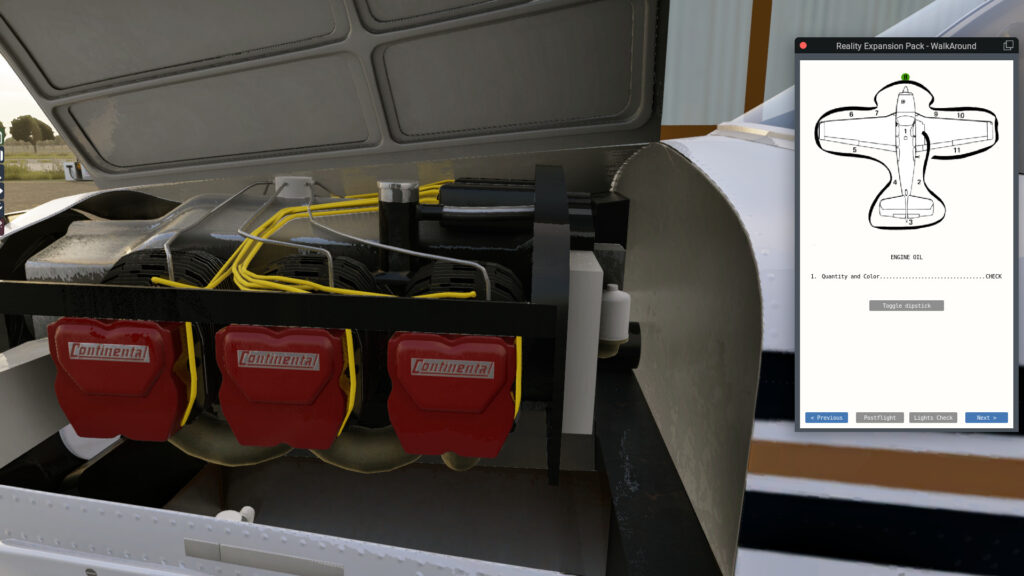
If you fly the PAE A36 or G36 Bonanza, the default Beech B58 Baron, or the default Cirrus SR22 with REP, you probably noticed an option in the Maintenance Report. You can pick a normally aspirated engine, or a turbonormalized (TN) one. Under the hood, all four aircraft share the same engine family: the Continental IO-550, just in different flavors. The Bonanza runs the IO-550-B, the Baron the IO-550-C, and the SR22 the IO-550-K.
Today we want to explain what the TN option really does on these engines. We’ll cover why it behaves differently from a normal turbo, and how to fly it without hurting anything.
What Turbonormalization Actually Does
A traditional turbocharged engine uses the turbo to push manifold pressure above sea-level values. More boost, more power, at any altitude.
A turbonormalized engine works differently. Instead of boosting past sea level, it only restores what altitude takes away. Therefore, the engine keeps producing roughly the same manifold pressure at 15,000 feet that it would produce at sea level. It doesn’t gain extra power the way a true turbocharged engine does.
This is the logic behind the Tornado Alley Turbo (TAT) “Whirlwind System” installation that REP models for these aircraft. An automatic wastegate regulates boost so the engine stays within safe limits. This extends the performance envelope, typically up to around 20,000 feet, before power starts tapering off.
Here’s a fun detail. The wastegate improves how exhaust gases exit the engine at altitude. Therefore, TAT documentation notes the system can deliver up to 5% more power than a fixed or manually controlled wastegate, for the same throttle setting. Better plumbing, free horsepower.
A Curiosity: The Wastegate Runs on Oil Pressure
The automatic wastegate isn’t electric. It’s actuated by engine oil pressure. This means a cold, thick oil slows down how fast the wastegate can respond to a throttle change.
Therefore, on a cold engine, a rapid throttle push can momentarily overboost the manifold before the wastegate catches up. This is one of the main reasons TAT insists on warming up the engine properly before takeoff. It’s also why REP ties wastegate behavior to oil temperature and pressure, rather than treating it as an instant, ideal system.
Flying It the TAT Way: WOT and “Everything Else”
Here’s the part that surprises most pilots moving to a turbonormalized engine for the first time. In cruise, you leave the throttle wide open. Full stop. This holds whether you’re flying the IO-550-B in the Bonanza, the -C in the Baron, or the -K in the SR22.
Traditional piston flying teaches you to manage power mostly with the throttle. TAT’s guidance flips that logic. Every internal combustion engine runs more efficiently at wide open throttle. So instead of throttling back to reduce power, you leave the throttle forward. You control horsepower with the propeller RPM and the mixture, operating lean of peak.
During the climb itself, keep it simple: full throttle, 2700 RPM, full rich mixture, and cowl flaps open.
The Cruise Procedure
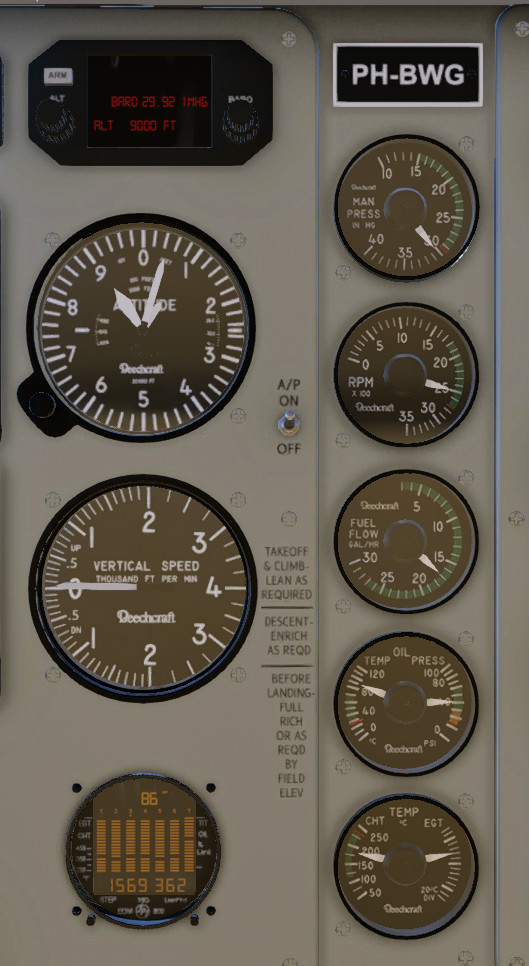
TAT’s own cruise procedure, the one REP follows, looks like this:
- Leave the throttle at WOT. Below roughly 18,000–22,000 feet, this typically gives around 30 inHg of manifold pressure.
- Set the prop governor to 2500 RPM.
- Lean the mixture until TIT sits 50–100°F on the lean side of peak. For the Whirlwind System III installation modeled in REP, that usually means a fuel flow of about 16.5–18.0 GPH on the IO-550. TIT itself will typically settle between 1500°F and 1600°F.
- Keep an eye on CHT and hold it under 380°F. If it creeps above that and doesn’t come back down, lean another 0.2–0.3 GPH.
Want less power for range? Don’t touch the throttle. Reduce RPM instead, down to 2400 or even 2300, but not lower while manifold pressure is above 25 inHg. Want more power back? Bring the RPM back up to 2500. The mixture setting barely needs to change either way.
This only works cleanly thanks to the turboGAMIjector fuel injectors. They balance fuel delivery across cylinders, letting RPM and mixture do real work as power levers instead of the throttle.
A Handy Shortcut: Calculating Horsepower
There’s a neat side effect too. Lean of peak is the only regime where you can calculate horsepower with a simple formula. No MAP, no RPM, no altitude needed:
Horsepower ≈ Fuel Flow (GPH) × 14.9
So if you’re burning 15.8 GPH lean of peak, you’re making roughly 235 horsepower. It’s a handy party trick next time someone asks how hard the engine is working.
How REP Simulates the Turbo
REP doesn’t treat the turbo as a simple pressure multiplier bolted onto the stock X-Plane engine. The turbocharger RPM, internal pressure, and temperature are all computed dynamically. They come from real engine parameters: delivered power, exhaust gas temperature, and mass airflow. Spool-up behavior, thermal effects, and power response all fall out of that model, instead of being faked with a lookup table.
The automatic wastegate targets roughly 8 inHg with the throttle closed, and around 31 inHg at WOT. That’s exactly how the real TAT installation behaves. The fuel injection system is a simple continuous-flow design, and it doesn’t compensate for altitude or manifold pressure on its own. That means leaning is entirely on you, especially as you climb.
How to Use It Without Breaking It
A few habits will keep this engine happy:
- Warm it up properly. Oil temperature and pressure should be in the green before you push the power up, since the wastegate depends on that oil to work correctly.
- Advance the throttle smoothly, especially at higher power settings. A rushed throttle push can overboost the manifold before the wastegate reacts.
- Watch the oil pressure gauge. A drop in oil pressure can push the wastegate open unexpectedly. This shows up as manifold pressure that doesn’t behave as expected.
- Follow the official TAT operating suggestions. REP’s implementation is built to match them closely. They also cover startup, climb, descent, and instrument approach nuances beyond this article.
- Consider the tuned fuel injectors, available from the Maintenance Report. They smooth out lean-of-peak operation and typically shave about 1 GPH off fuel burn.
Where to Learn More
The full turbo chapter is available in the REP user manual for each supported aircraft. It covers manifold pressure behavior with RPM, altitude, and airspeed in more depth. TAT’s own operating suggestions document for the turbonormalized IO-550 is also worth a careful read before your first high-altitude leg.
Fly smooth, lean properly, and let that wastegate do its job.